



Ceramic vs. Semi-Metallic Brake Pads: What’s The Difference?
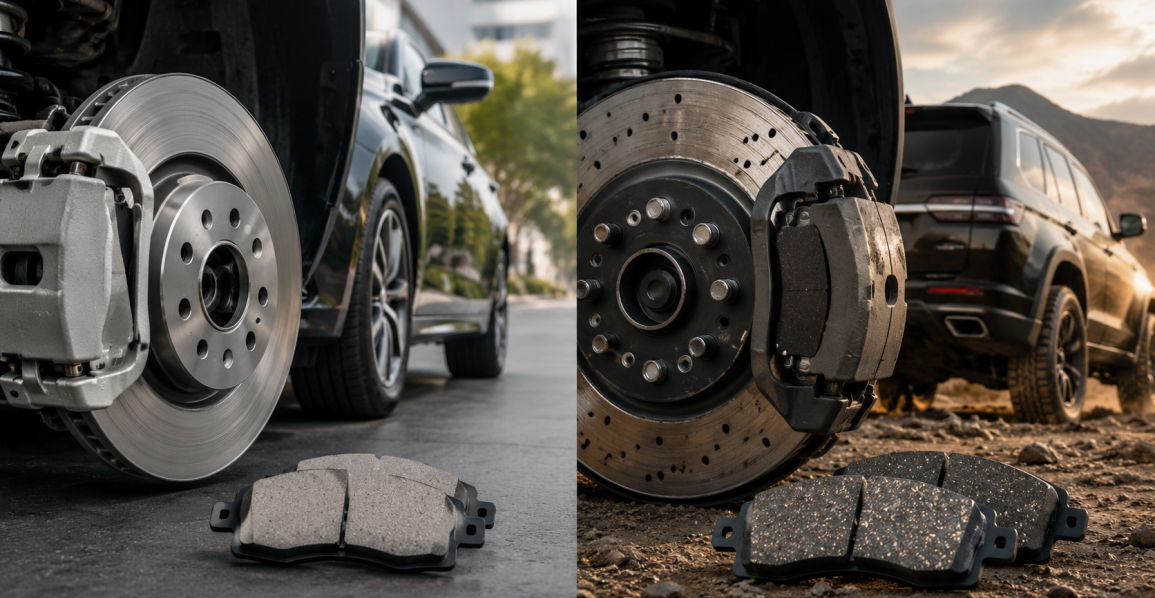
In light of modern trends toward enhanced vehicle performance, extended durability, and environmental sustainability, purchasing the correct brake pads is of critical importance. Incorrectly selected components can lead to a significant reduction in braking efficiency, the overheating of brake discs (rotors), and may even result in traffic accidents.
Why Brake Pad Selection is Critical in 2025
The selection of brake pads has become a decisive factor in 2025 because it directly influences three major pillars of automotive usage: safety (braking efficiency and the reduction of stopping distances), driving comfort (the mitigation of noise, vibration, and harshness), and operational costs (longevity of the pads and reduced wear on the rotors). Whether one should choose ceramic or semi-metallic brake pads depends entirely on the specific driving style and operating conditions.
The Role of Brake Pads in Vehicle Safety
Brake pads are a component that has a direct and immediate impact on driving safety. Their function is not merely to stop the car, but to manage kinetic energy through friction.
Their primary roles include:
- Generation of Friction: Creating the necessary frictional force between the pad material and the spinning brake disc to convert kinetic energy into thermal energy.
- Reduction of Stopping Distance: Ensuring the vehicle comes to a complete halt in the shortest possible distance during emergency maneuvers.
- Braking Balance: Facilitating uniform braking across all wheels to prevent skidding or loss of vehicular control.
- Thermal Resistance: Providing resistance to overheating, a phenomenon known as "brake fade," where braking power is lost due to excessive heat build-up.
- System Integration: Effective interaction with other safety systems, such as Anti-lock Braking Systems (ABS) and Electronic Stability Control (ESC).
The condition and correct selection of brake pads is not simply a matter of acoustic comfort; it is the factor that determines a driver's ability to maintain control over the vehicle and avoid emergency situations or collisions.

Key Trends of 2025: Durability, Ecology, and Performance
The future appearance and functionality of braking systems are based on growing requirements for safety standards, increased performance, and economic efficiency.
In 2025, manufacturers are focusing their research and development on the following directions, which makes the consumer's choice even more important:
- DurabilityDurability and Longevity: Modern pads are being developed using advanced composite materials that boast a significantly longer service life, thereby reducing the frequency of replacement and lowering long-term maintenance costs.
- Environmental Sustainability: There is an intensifying trend toward the use of eco-friendly materials. This includes a major shift toward "low-copper" or "copper-free" formulas, as well as the complete elimination of asbestos and other hazardous volatile compounds.
- High Performance: New manufacturing technologies allow for the creation of pads with a higher and more stable coefficient of friction, superior heat dissipation capabilities, and minimal levels of noise generation and dust emission.
In 2025, a brake pad is no longer a simple consumable commodity; it is a high-tech, intelligent, and environmentally conscious component.
Who Needs to Pay Special Attention? (City Drivers, Speed Enthusiasts, Commercial Transport Owners)
Different driving environments require vastly different friction materials.
- City Drivers: For this demographic, pads with a fast initial "bite" (reaction to braking) and low noise levels are paramount. Since city driving involves frequent braking events (traffic lights, pedestrian crossings, traffic jams), the components must be resistant to frequent "heat-up and cool-down" cycles. For these conditions, ceramic pads are often the optimal choice due to their stability and cleanliness.
- Speed Enthusiasts and Sport Drivers: For these drivers, high performance and resistance to extreme overheating are critical. At high speeds, the braking system experiences colossal thermal loads. Semi-metallic or specialized ceramic pads designed specifically for sports cars are recommended here to prevent fade.
- Owners of Commercial Transport: For this group, exceptional durability and wear resistance are the priorities. These vehicles constantly operate under heavy loads, which leads to rapid wear of standard braking systems. Selecting specialized, heavy-duty pads with an extended resource life helps reduce operational expenses (TCO) and minimizes vehicle downtime.
The Evolution of Brake Pads: From Asbestos to Modern Materials
The history of brake pad development began with simple solutions and has evolved into a complex material science. It started with simple wooden blocks pressed against wheels in horse-drawn carriages and was later adapted for early automobiles in the late 19th and early 20th centuries.
History of Development
The first braking systems were primitive. In the horse-drawn era of the late 19th century, brake pads were made of wood, and later, metal with leather linings was used. However, as the speed and power of automobiles grew, these organic materials ceased to cope with the increased friction and heat.
In the early 20th century, a material was found that seemed ideal for the time: asbestos. Due to its high heat resistance, structural strength, and good coefficient of friction, asbestos linings became the industry standard. Asbestos fibers reinforced the friction material, making it durable and resistant to wear under high temperatures.
However, progress did not stand still. Asbestos was eventually replaced by non-asbestos organic (NAO) friction materials. Today, there are several main types of brake pads, each with its own distinct characteristics, primarily divided into ceramic and semi-metallic.
Why the Industry Abandoned Asbestos Pads
The decision to phase out and ban asbestos pads was driven by serious problems related to human health and environmental safety.
- Carcinogenicity: In the 1970s and 1980s, medical research irrefutably proved that asbestos is a potent carcinogen. Inhaling the microscopic fibers released during braking could cause mesothelioma and other lung diseases.
- Occupational Safety: The production of asbestos pads was incredibly dangerous for factory workers who were constantly exposed to asbestos dust. Mechanics changing brakes were also at high risk.
- Environmental Issues: Asbestos dust released into the atmosphere settled on roads and washed into waterways, polluting the environment.
As a result, many countries, particularly in Europe and North America, introduced strict legislative restrictions and bans on the use of asbestos in brake pad production. This forced the industry to innovate, leading to the introduction of safer, high-performance materials.
Modern Materials and Manufacturing Technologies
To understand the difference, we must look at the composition.
- Semi-Metallic Brake Pads: These contain anywhere from 30% to 65% metal components (including iron, copper, steel wool, and brass) combined with organic fillers and friction modifiers. They are known for being durable, guaranteeing high braking efficiency, and dissipating heat away from the rotor very well. However, they can be noisier and tend to wear down the brake disc faster due to their abrasive nature.
- Ceramic Brake Pads: These are manufactured from a dense mixture of ceramic fibers, bonding agents, non-ferrous fillers, and sometimes small amounts of copper. They are practically silent, produce very light-colored dust that does not stick to wheels, and provide excellent braking efficiency at high temperatures. They generally wear slower than other types. The main downside is the typically higher price point.

The Anatomy of Brake Pads: Detailed Composition
Ceramic Pads
|
Component Category |
Details |
|
Composition |
Ceramic fibers (often aluminum oxide), Bonding agents (high-grade phenolic resins), Fillers (silicon, graphite). |
|
Production Process |
Preparation of raw materials; Molding of billets under pressure; Thermal treatment (curing/scorching); Mechanical machining; Quality control. |
|
Characteristics |
Quiet operation, low vibration transfer, consistent braking, reduced wear on mating brake discs. |
Semi-Metallic Pads
|
Component Category |
Details |
|
Materials |
Mixture of metals (copper, iron, steel) up to 65%. Organic components (resins, glass, rubber). Ceramic and Kevlar fibers for reinforcement. |
|
Structure |
Multi-component composite with a coarser surface texture. Often feature slots for dust and gas evacuation. |
|
Characteristics |
Highly effective in a wide temperature range (up to 400–500 °C). Wear down brake discs faster than ceramic or organic options. Suitable for heavy vehicles, SUVs, and trucks. Used extensively in sports and high-load systems. Excellent for aggressive driving styles and frequent heavy braking. |
Influence of Composition on Operational Properties
The chemical and physical composition of brake pads directly influences their real-world characteristics because different materials possess different physico-chemical properties. These properties determine exactly how the interaction with the brake disc or drum occurs at the microscopic level.
Detailed Comparison: Ceramic vs. Semi-Metallic
|
Criterion |
Ceramic Brake Pads |
Semi-Metallic Brake Pads |
|
Braking Efficiency |
Excellent at low to medium temperatures; extremely stable in city and highway conditions. |
Maximum efficiency at high temperatures; superior for sports driving and towing heavy loads. |
|
Performance Under Heat |
Can lose some efficiency (fade) under extreme, racing-level heat, though stable for street use. |
Excellent friction retention during overheating; dissipates heat rapidly. |
|
Durability (Pad Life) |
Longer service life under moderate driving conditions; provides very uniform wear. |
Medium service life; resource is higher under heavy use, but wears faster in stop-and-go city traffic. |
|
Rotor (Disc) Wear |
Minimal; very gentle on the rotor surface, extending the life of the brake discs. |
Accelerated wear on rotors; potential for corrosion on the rotor due to metallic dust interaction. |
|
Noise Levels |
Extremely quiet and comfortable; rarely squeak due to frequencies outside human hearing. |
Can be noisy; more prone to squeaking, grinding, or vibrating depending on conditions. |
|
Dust Emission |
Produces light, fine dust that is non-adhesive and barely visible on wheels. |
Produces dark, corrosive, and aggressive dust that is very visible on rims. |
|
Driving Comfort |
Soft, progressive, and predictable pedal feel. |
Firmer, "harder" pedal response; provides more feedback but requires getting used to. |
|
Price Point |
Generally more expensive to purchase initially. |
Generally cheaper to purchase initially. |
|
Economic Efficiency |
Profitable in the long term (less rotor wear and wheel cleaning required). |
Economical at the start; may be more cost-effective regarding price/performance ratio in heavy-duty use. |
|
Recommended Application |
City driving, daily commuting, family sedans, luxury/premium segment vehicles. |
Sports cars, towing vehicles, SUVs, heavy commercial transport, mountainous terrain routes. |
Specialized Operating Conditions
Different environments demand different tools. Here is how they stack up in specific scenarios:
|
Operating Condition |
Ceramic Pads |
Semi-Metallic Pads |
|
City Driving (Frequent stops, traffic jams) |
Ideal. Quiet, comfortable, generates minimal dust. Performance is slightly weaker when "cold" (first stop of the day). |
Good grip even when cold. However, generates noise and dust, and accelerates disc wear in stop-and-go traffic. |
|
Highway Driving (High speeds, prolonged braking) |
Sufficiently stable for moderate driving. Possible brake fade if overheating occurs during emergency stops from very high speeds. |
Excellent. Superior performance at high temperatures. High reliability during active or aggressive driving. |
|
Sport / Track (Extreme loads) |
Generally do not withstand extreme track heating (unless specialized racing ceramic). Fast wear under track conditions. |
Preferred. Resistant to overheating. High efficiency on the track due to high metal content assisting heat transfer. |
|
Commercial Transport (Heavy loads) |
Rapid wear under heavy load. Suitable only for light commercial vehicles (minivans). |
Optimal for heavy machinery. Durable under intense operation and heavy payload weight. |
|
Hot Weather |
Stable operation, but may lose efficiency if the system heat soaks completely. |
Excellent thermal resistance and recovery. |
|
Cold Weather |
Less effective on the very first stop when freezing cold. |
Maintains high efficiency and bite even in freezing temperatures. |
|
Humidity / Rain |
Stable, but "wake up" (bite) slightly slower when wet. |
Quickly restores efficiency after getting wet due to abrasive surface. |
Expert Choice: Best Brands and Models of 2025
The market is flooded with options, but experts have identified clear leaders for 2025.
- Ceramic (Top Tier): Bosch QuietCast, Akebono ProACT, Power Stop Z-Series. These are renowned for absolute silence, low dust generation, and stability.
- Semi-Metallic Leaders: TRW, Ferodo, Brembo. These brands are synonymous with reliability, heat dissipation, and performance in heavy-duty conditions.
- Innovations: Look for "Eco-formulas" that are copper-free, new composite materials from Brembo, and pads featuring integrated wear sensors compatible with IoT (Internet of Things) vehicle systems.
Price/Quality Recommendations:
- Budget Segment: Ceramic pads are often the best value for standard city cars.
- Mid-Range Segment: Semi-metallic or Sport-Ceramic blends for mixed driving modes.
- Premium Segment: Advanced composites and high-performance sport solutions for extreme loads.
Experts strongly recommend focusing on these established brands to ensure safety and performance.
Ceramic vs. Semi-Metallic vs. Organic: A Complete Comparison
While we have focused on the two main types, it is important to see the full picture including Organic (NAO) pads.
|
Brake Pad Type |
Advantages |
Disadvantages |
Resource |
Price |
|
Ceramic |
Quiet operation, resistance to thermal breakdown, significantly less dust, rotor friendly. |
More expensive, performance drops in extreme cold or extreme track heat. |
Long |
High |
|
Semi-Metallic |
Excellent braking bite even when hot, durable, transfers heat away from the pad. |
Noisy, abrasive (wears the disc faster), generates dirty dust. |
Medium |
Medium |
|
Organic (NAO) |
Soft pedal feel, quiet, inexpensive, gentle on rotors. |
Wears out very quickly, loses efficiency rapidly when heated (fade), dusty. |
Short |
Low |
When Each Type Objectively Wins

Each type of brake pad reveals its strengths in different operating conditions, so the choice ultimately depends on the driving style and the specific tasks of the vehicle.
- Ceramic wins objectively for city operation and premium automobiles, where the most important factors are acoustic comfort, silence, and keeping the wheel rims free of black dust.
- Semi-Metallic wins in conditions of active driving and heavy loads (sports driving, off-roading, SUVs, towing trailers), as it withstands high heat and maintains structural stability.
- Organic pads are suitable for calm driving around the city in budget cars, where the main criteria are low price and soft braking, and longevity is not a priority.
There is no universal solution—it is strictly necessary to select the part based on the specific driving style and requirements.
Hybrid and Composite Solutions
Today, manufacturers often combine materials to create hybrids. For example, organic compounds reinforced with metallic fibers, or ceramic matrices with added copper (where legal). Such pads combine the silence and softness of organic materials with the thermal resistance of metal, or the longevity of ceramic with a more accessible price point.
Practical Guide to Selection and Replacement

The selection and timely replacement of brake pads directly affects traffic safety and the longevity of the entire braking system. It is important to consider the type of vehicle, driving style, and the quality of the components to ensure optimal brake operation and avoid unnecessary expenses.
How to Determine the Type of Pads on Your Car
You can determine the necessary type by the VIN code (Vehicle Identification Number), by looking at the information in the vehicle's service manual, or by visual inspection of the removed parts (manufacturer codes are often stamped on the backplate). It is also worth considering the make and model of the car, the year of manufacture, and the specific modification of the braking system, because even within one model range, different braking options may be installed (e.g., a "Sport" trim may have different pads than a "Base" trim).
Signs of Wear and Necessity of Replacement
The main signs of worn-out pads include:
- Audible screeches or squeals during braking (wear indicators).
- Increased stopping distances.
- Vibration or pulsation in the brake pedal or steering wheel.
- Warning lights on the dashboard.
- If the thickness of the friction layer has decreased to the minimum mark (usually 2-3mm), replacement becomes mandatory.
The Replacement Process: DIY or Service Center?
Replacing pads with your own hands is possible if you have the relevant experience and tools (jack, lug wrench, caliper tool, torque wrench), but it requires attention to detail and adherence to safety regulations. If there is no confidence in your own abilities, it is better to entrust the work to a professional service center, where they will conduct a full diagnostic of the caliper and rotor and install the parts with a warranty.
Bedding-In New Pads: Rules and Recommendations
After installing new pads, a "bedding-in" or "burnishing" period is necessary. For the first 200–300 km, it is important to avoid sharp, panic braking and extreme loads. This process transfers a thin layer of friction material to the brake disc (rotor) and ensures the two surfaces mate perfectly, providing maximum braking efficiency and preventing noise or vibration later.
Compatibility with Brake Discs
When choosing pads, it is important to consider compatibility with the material and condition of the brake discs. Low-quality or mismatched pads (e.g., putting aggressive semi-metallic pads on soft, non-performance rotors) can accelerate disc wear, reduce braking efficiency, and cause annoying noises.
Conclusion: The Optimal Choice for Different Needs
The choice depends on finding the balance between safety, comfort, and durability. The modern market offers solutions for any task—from quiet city commuting to dynamic sports styles—and it is important to orient oneself based on the real needs of the driver.
Personalized Recommendations for Different Driving Styles
- For calm drivers who value comfort, silence, and clean wheels, Ceramic pads are the suitable choice.
- For those who frequently drive on the highway, tow loads, or prefer a dynamic/aggressive style, it is worth choosing Semi-Metallic pads.
- Organic pads can be a universal solution for budget-conscious daily operation without special loads or high speeds.
The Future of Brake Pad Technologies
In the coming years, we expect the development of even more advanced eco-friendly compounds that drastically reduce dust emissions and disc wear (driven by Euro 7 regulations). Furthermore, we will see the widespread implementation of "smart" sensors embedded in the friction material that will track the condition and temperature of the pads in real-time, sending data to the car's computer. This will increase safety and make vehicle maintenance more predictable and efficient

