



Chinese Electric Cars vs Global EVs: How They Compare in Performance, Range, and Technology
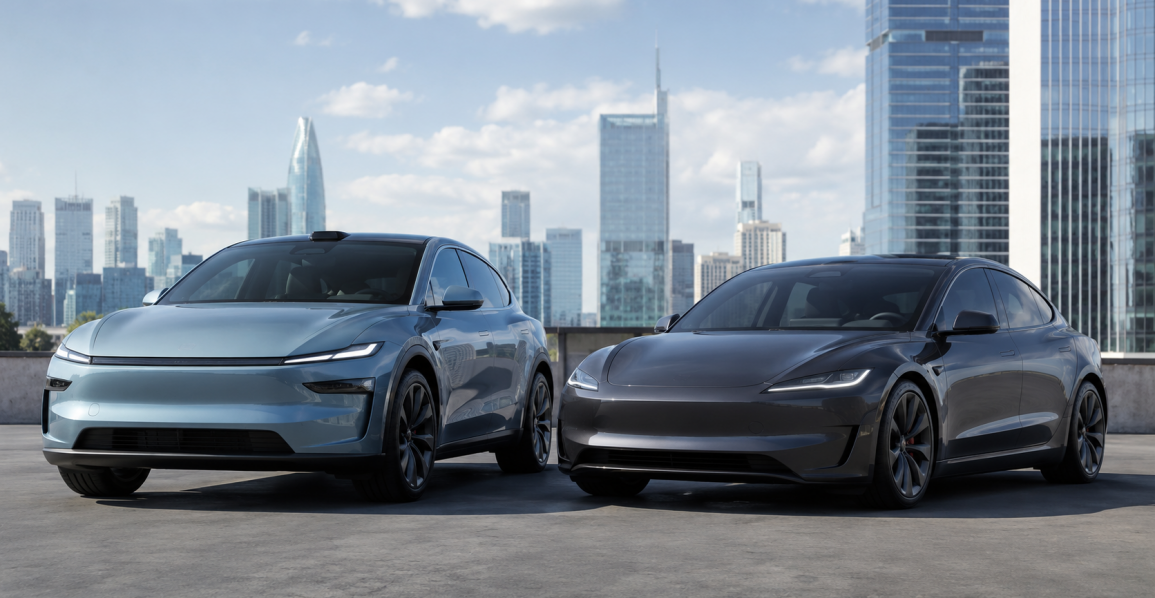
Chinese electric cars have already secured strong positions in the global market and now compete directly with Tesla, Volkswagen, Hyundai, Kia, BMW, and other manufacturers. For buyers, the main question is simple: how do they compare with global models in performance, range, batteries, technology, and overall ownership experience?
In this article, we will look at how Chinese electric cars compare with global EV manufacturers and where they lead, fall behind, or have already caught up.
Chinese Electric Cars in the Global Market
China has long since stopped being just a major production base for EVs. It is now the main market shaping volumes, development speed, and price pressure across the entire EV segment. Chinese electric cars hold strong positions not only inside the country, but also increasingly on export markets.
The key leaders here are well known. BYD has become a benchmark for scale, vertical integration, and battery technology. NIO focuses on the premium segment, digital ecosystem, and service solutions. XPeng is more strongly associated with rapid technology updates, driver assistance systems, and modern platforms. These brands are the most logical basis for comparison because they represent different approaches within the Chinese market itself.
China’s growth is driven by several factors at once:
- the scale of domestic demand;
- active government support, including tax incentives and vehicle replacement programs;
- the speed of launching new models and intense domestic competition, which pushes manufacturers to improve equipment, batteries, and digital functions faster.
Exports also matter. Chinese electric cars have already gained noticeable traction in Europe, Southeast Asia, Latin America, and other external markets. For buyers, this matters for a simple reason: a Chinese EV today is no longer just a local product for the domestic market, but a full-fledged global competitor.
Global EV Manufacturers
If Chinese brands compete through scale and speed of renewal, global manufacturers are strong in other areas. They have more developed international service networks, stronger brand recognition, and their vehicles are often seen as a more familiar and predictable choice outside China.
The main reference point in this comparison is Tesla. For a long time, it set the standard for the mass-market EV in performance, software logic, and the overall perception of EVs as technological products. But today Tesla no longer looks like the only point of reference. Alongside it stand Volkswagen, Hyundai, Kia, BMW, and other companies that rely on their own strengths.
Volkswagen is stronger in large family-oriented formats, range, and calm everyday use. Hyundai and Kia stand out for fast-charging architecture and well-developed platforms. BMW is stronger in the premium segment, where not only numbers matter, but also ride quality, materials, and overall engineering refinement.
That is why global electric cars do not win through one universal advantage, but through a combination of three things:
- mature platforms;
- developed service and dealer networks;
- predictability of ownership in different countries.
This is the background against which Chinese electric cars now have to be compared, not through loud claims, but through real specifications and actual ownership experience.
Performance Comparison
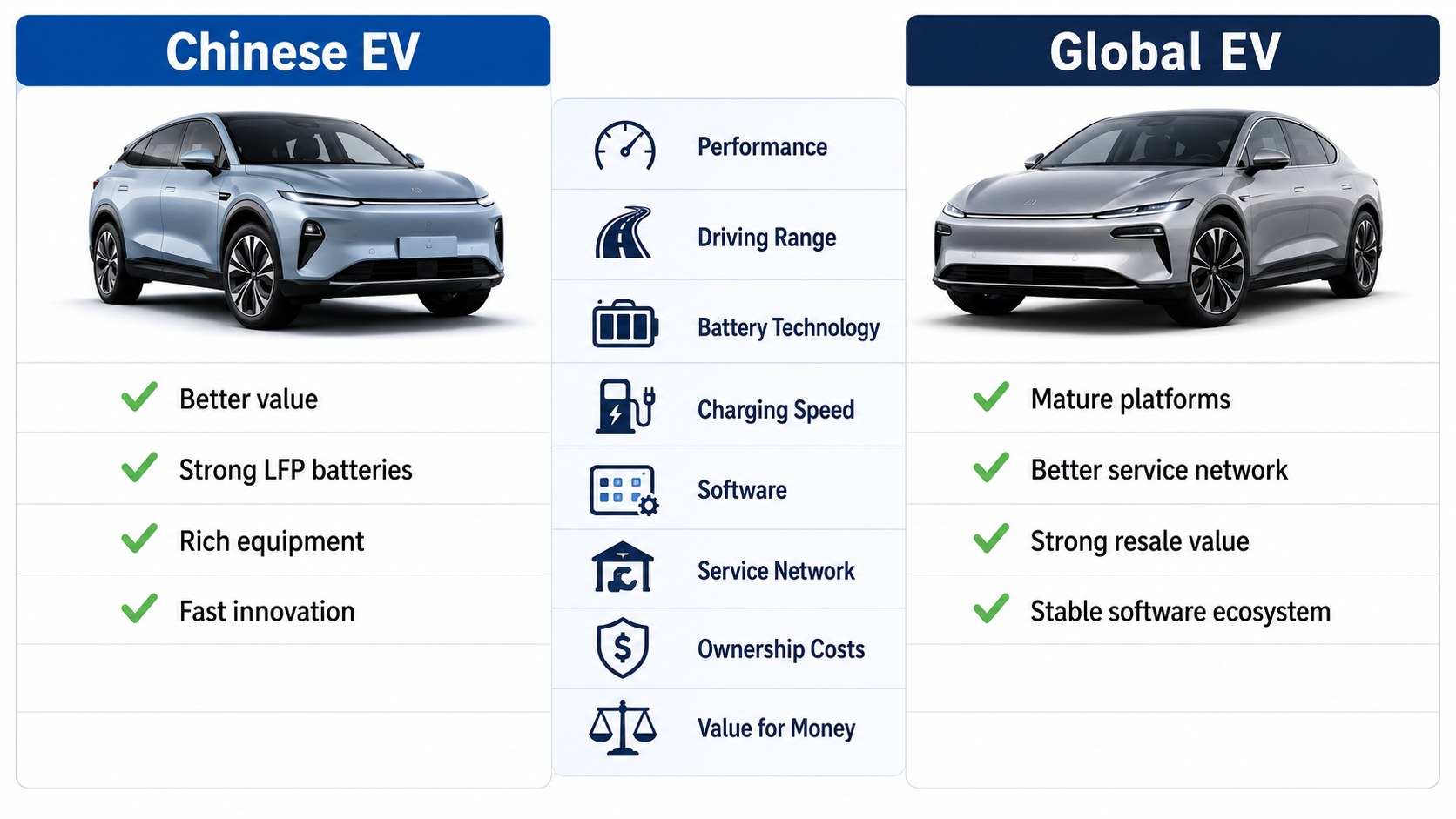
To avoid an abstract comparison, it is better to look at specific models from similar segments.
|
Model |
Market |
Power |
Torque |
0–100 km/h |
Top speed |
|
XPeng G6 AWD |
China |
350 kW |
660 Nm |
4.0 s |
200 km/h |
|
NIO ET5 AWD |
China |
360 kW |
700 Nm |
4.0 s |
200 km/h |
|
Tesla Model 3 Long Range AWD |
Global |
366 kW |
n/a |
4.4 s |
201 km/h |
|
Tesla Model 3 Performance |
Global |
460 kW |
n/a |
3.1 s |
262 km/h |
|
Hyundai IONIQ 5 AWD |
Global |
239 kW |
605 Nm |
5.3 s |
185 km/h |
The numbers show the main point clearly. Chinese electric cars no longer trail global models in the mid-size and upper mid-size segments when it comes to acceleration and torque. The XPeng G6 and NIO ET5 deliver a level that directly competes with the Tesla Model 3 Long Range and looks stronger than the Hyundai IONIQ 5 AWD specifically in performance.
But leadership depends on the use case. If you want the fastest mass-market electric sedan, the Tesla Model 3 Performance still looks stronger. If you want a fast and well-equipped electric car without moving into the most expensive segment, Chinese models already look very competitive.
For buyers, the important point is not just the 0–100 km/h figure, but how that performance works together with vehicle weight, range, and chassis tuning. That is exactly why electric cars cannot be compared by one parameter alone: quick acceleration does not automatically make a model the best choice.
Range and Batteries

When it comes to range, Chinese electric cars no longer look like the weak side of the market. Some models offer figures comparable to Tesla, Volkswagen, and Hyundai, and in some cases Chinese brands make extra-long official range a separate competitive advantage.
But range must be compared carefully. Real-world results depend not only on battery capacity, but also on vehicle weight, aerodynamics, regeneration settings, temperature, and driving speed. That is why an electric car with a larger battery is not always the most efficient in everyday use.
Chinese manufacturers are especially strong in LFP batteries. Their main advantages are safety, durability, and a clearer cost structure. Global manufacturers more often use NMC or NCM solutions, which deliver high energy density but are usually more expensive and more dependent on the balance between weight, range, and price.
For buyers, four parameters matter most here:
- real-world rather than only official range;
- battery type;
- charging speed;
- compatibility with available infrastructure.
Battery technology is exactly where Chinese electric cars are especially strong right now. They scale LFP faster, reduce costs more aggressively, and already offer competitive range not only in expensive models, but also in the mid-market segment.
Technology and Innovation

In digital terms, Chinese electric cars often look even more aggressive than global models. Chinese manufacturers update interfaces faster, add large screens more actively, expand driver-assistance systems, voice control, and digital in-cabin functions more quickly.
NIO and XPeng are especially strong in treating the vehicle as a software platform. For them, not only the powertrain and battery matter, but also the user experience: screens, menu logic, driver assistance, smartphone integration, and update frequency.
Global manufacturers more often focus on more restrained and mature integration. Tesla remains a benchmark for software and the overall logic of a digital vehicle. Hyundai and Volkswagen are stronger in balancing new features with familiar ergonomics. BMW focuses on premium interface quality and more refined tuning of electronic systems.
In this comparison, the difference usually looks like this:
- Chinese brands introduce new digital functions faster;
- global brands more often offer more predictable and stable implementation;
- Chinese models push harder on the amount of technology for the same money;
- global models are stronger in ecosystem maturity and function calibration.
So the question here is not who has more screens. What matters more is whether those technologies actually help in daily driving instead of simply making the cabin look more impressive.
Design and Ergonomics
In terms of design, Chinese electric cars have long moved past the stage where they were seen as styling variations of someone else’s ideas. They now more often look like fully independent models with serious attention to aerodynamics, lighting, and interior layout.
The biggest difference between Chinese and global EVs is now more noticeable inside than outside. Chinese brands often make the cabin more visually striking: large displays, very few physical buttons, clean lines, and a bright digital presentation. Global manufacturers are more often stronger in seating position, visibility, control logic, and overall long-distance ergonomics.
For buyers, practical points matter more than abstract language about style:
- is it easy to get in and out;
- is the interface overloaded;
- is visibility good enough;
- is the cabin comfortable in real driving, not only in a showroom.
This is exactly where some global models still have an advantage. Chinese electric cars often win on visual effect and equipment, but they are not always equally strong in the small details that begin to matter after a few months of ownership.
Reliability and Maintenance
Reliability in an electric car is not only about battery life. For a real owner, service, parts availability, electronic stability, and predictable operation in different climates matter just as much.
Chinese manufacturers are strong in rapid battery progress and fast platform updates. But outside China, service infrastructure may still be a weak point. If a brand is only entering a market, it does not yet have the same dense service network as global manufacturers.
For global brands, the advantage usually looks like this: warranty support is clearer, service networks are broader, and access to maintenance is easier in different countries. This matters most for buyers who want an electric car not as a tech novelty, but as their main everyday vehicle.
When assessing reliability, do not look only at the brand. Look at four practical questions:
- what battery life is claimed;
- how the warranty is structured;
- whether there is service nearby;
- how well the model has already been proven in real-world use.
This is exactly where Chinese electric cars may be very strong as products, but weaker in ownership infrastructure outside their home market.
Price and Value for Money
On price, Chinese electric cars often look like the strongest argument against global models. In many segments, they offer more power, more equipment, and a more modern interior for the same money or less.
This is especially noticeable in the mid-size class. Where a global electric car often requires extra payment for a larger battery, more power, or more technology, a Chinese model may already offer a fuller equipment package in the base or mid-level version.
But price should not be judged only at the starting point. Other costs matter too:
- charging cost;
- maintenance;
- warranty;
- resale value;
- parts availability.
That is why Chinese electric cars often win on price-to-equipment ratio, while global electric cars are stronger in ownership predictability and residual value. For one buyer, maximum output for the money matters most. For another, calmer operation and clearer service matter more.
Outlook and Trends
In the coming years, China’s influence on the EV market will only grow. Chinese manufacturers are already strong in scale, batteries, speed of launching new models, and price. The next stage is further expansion on foreign markets and stronger pressure on global brands not only in the mass segment, but also in the premium segment.
At the same time, global manufacturers will respond not only with new models, but also with redesigned platforms, revised battery strategies, and charging ecosystems. Competition is already shifting away from the simple question of who makes EVs toward a tougher comparison of price, range, charging speed, software logic, and service.
Over the next five years, the market will most likely change in three directions:
- Chinese EV exports will continue to grow;
- battery technology will become even more important in competition;
- service and charging infrastructure will influence the buying decision more than before.
That means one simple thing: the comparison between Chinese and global EVs will only become tougher, while the gap between them in quality and technology will continue to shrink faster.
What Should a Buyer Choose?
The choice between a Chinese and a global EV does not depend on the country of origin by itself. It depends on your priorities.
If price, rich equipment, strong digital features, and a strong set of specifications for the money matter most, Chinese electric cars often look stronger. This is especially visible in the mid-size segment, where they offer a lot of car for the same budget.
If service, a familiar brand ecosystem, predictable ownership, and clearer resale value matter more, global electric cars often look calmer and more rational.
It is easier to decide by use case:
- for city use and daily trips with a focus on price and technology, a Chinese EV is often the better value;
- for long trips, where service and a mature ecosystem matter, Tesla, Hyundai, Volkswagen, and other global brands may look stronger;
- in the premium segment, the choice already depends on whether digital presentation or engineering maturity matters more.
So the best choice is not the model with louder marketing claims. It is the one whose strengths actually match your real use case.
Conclusion
Chinese electric cars can no longer be seen as alternatives chosen only because of a low price. In performance, range, batteries, and digital functions, they already compete directly with world leaders in many segments, and in some areas they already look stronger.
Global electric cars still have a clear advantage where mature platforms, service infrastructure, ownership predictability, and brand strength outside the home market matter most. But the gap between them and Chinese manufacturers is shrinking very quickly.
The main conclusion is simple: Chinese electric cars, electric cars, and any individual electric car should be compared by real parameters, not stereotypes. The more clearly you understand whether price, range, technology, or service matters most to you, the easier it becomes to choose the vehicle that actually fits your use case.

