



International Driving Permit vs Cyprus Driving Licence: What Expats Should Consider
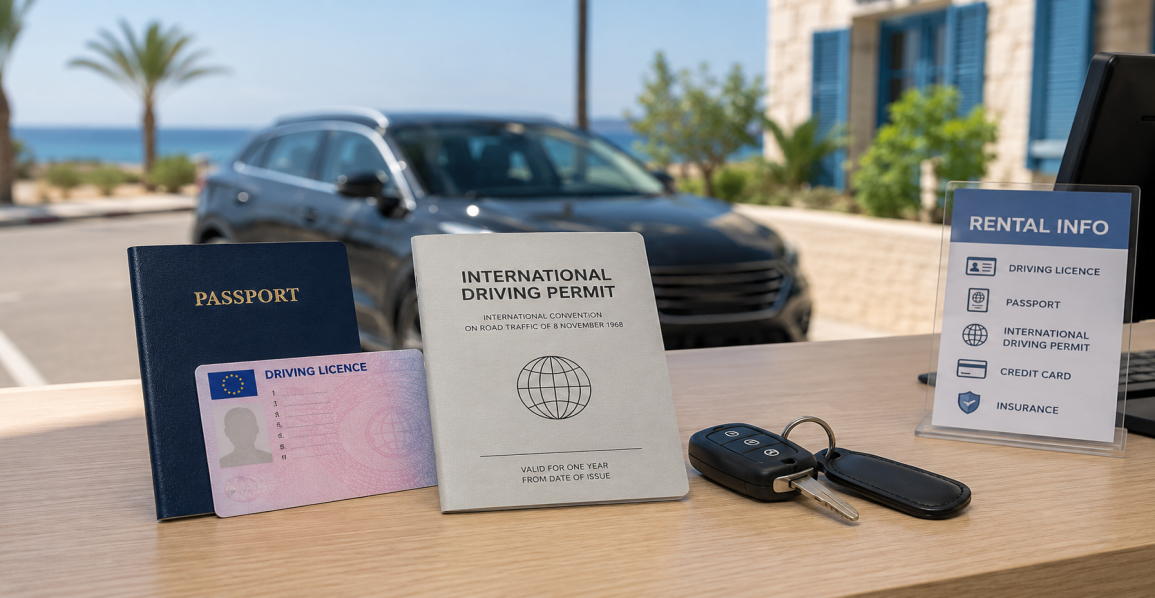
For a newcomer to Cyprus, an international driving permit (IDP) can seem like the simplest solution. The document is familiar, is normally obtained faster than a Cyprus driving licence and allows someone to get behind the wheel without navigating local bureaucracy. However, on Cyprus the decision is not only about convenience. Resident status, the country that issued your national licence, length of stay and the way that police, insurers and rental companies view your documents all matter.
In practice, an IDP never replaces a valid national licence. Under the United Nations conventions, an IDP is issued only to a holder of a valid national licence and must be presented together with that national licence, not instead of it. This is why the biggest mistake many expats make is to treat an IDP as an independent “international licence” when it is legally only a supporting document.
A Cyprus driving licence becomes truly important when a person is not just visiting:
- They live on the island permanently.
- They are arranging vehicle insurance.
- They are buying a car.
- They plan to work as a driver.
- They want to avoid questions from rental companies and state authorities.
There is no single answer that fits everyone. A tourist and a long‑term resident need different solutions.
What an IDP Is and Why It Exists

An IDP is a standardised international document linked to your national licence. Its purpose is to confirm that the holder already has the right to drive the relevant category of vehicle and to make licence data easier for foreign authorities and companies to understand. Cyprus is a party to the 1949 Geneva Convention on Road Traffic, and the international system of IDPs is built on those convention rules.
Put simply, an IDP is convenient when national licences are not obvious to local staff, are not written in the Latin alphabet or the driver goes to a country where rental companies and insurers are used to asking for an additional international document. It does not give you new categories, does not override local rules and does not serve as an independent basis for driving in your country of residence.
You normally obtain an IDP in your country of habitual residence through an authorised organisation. The exact paperwork depends on where you live, but the basic requirements are the same:
- A valid national driving licence.
- An application form.
- A photograph and payment of the required fee.
It is important to arrange the IDP before moving or travelling rather than hoping it can be legalised afterwards on the island.
How Foreigners Can Drive in Cyprus in the First Months

For short‑term visits, international agreements are important but so is the individual’s status. Official Cypriot procedures for obtaining and exchanging a Cyprus driving licence depend on habitual residence – at least 185 days per year in the Republic. The same threshold matters in practice: until a person becomes a habitual resident, driving questions are usually resolved by recognising the foreign licence; once that status is established, the topic shifts to exchanging or obtaining a local licence.
For many expats, an IDP is a practical bridge during the initial period. It makes it easier to explain the information in your licence during checks or when renting a car, especially if the national document is not from the EU and not in English. However, you cannot rely on an IDP indefinitely. After a certain time and when moving toward habitual residence, Cyprus expects a more stable document status.
Renting a Car
Car hire is a separate topic. The law and rental rules are not the same. Even if your right to drive is generally recognised, a rental company can set its own conditions: minimum age, minimum years holding a valid licence, a mandatory passport and sometimes an additional international document. For example, at Sixt in Cyprus the renter and any additional drivers must present full valid licences held for at least two years along with identity cards or passports. Local companies can be even stricter.
Road Conditions and Driving Style
There is also a road factor that newcomers often overlook. Cyprus drives on the left, road signs of the international type are placed on the left, and on motorways the maximum speed is 100 km/h and the minimum is 65 km/h. For drivers used to right‑hand traffic this is more than a formality; it is a real risk in the first days, especially on roundabouts and when entering from a secondary road.
When It Makes Sense to Get a Cyprus Driving Licence

As soon as life on the island becomes long‑term, changing your documents stops being theoretical. Official Cypriot procedures show that for several actions with a local licence a foreigner must prove habitual residence in the Republic. For a foreign applicant, the Road Transport Department requires at least 185 days of residence; for nationals of countries outside the EU it also requires a Foreigner’s Registration Certificate and a residence permit.
A Cyprus driving licence is usually sensible in three situations:
- You have already established yourself on the island.
- You want to minimise questions about insurance and car rental.
- You plan to use a vehicle not occasionally but as a regular tool for daily life and work.
For local authorities, a Cyprus licence is a clear and verifiable document. For a resident, it is more stable than constantly juggling foreign paperwork and expiry periods.
EU and Non‑EU Licences
If you already have a valid licence issued by an EU country, most other EU countries recognise it until it expires. This is an EU‑level rule. When it expires, is lost or certain administrative actions are required, the matter is handled through your country of residence. In other words, an EU licence holder is in a more comfortable position than someone with a licence from a third country.
If your licence is not from the EU, the key question is whether you can exchange it directly or must follow the local procedure to obtain a new licence. You cannot rely on chat rumours: Cyprus distinguishes between categories of foreign licences, and the outcome depends on the country of issue, residence status and specific procedure at the Road Transport Department. Before submitting your documents, check the official rules for your country rather than treating another person’s case as a general rule.
Documents, Tests, Timelines and Costs
Under the official procedures of the Republic of Cyprus, applying for a local licence requires proof of habitual residence. Published procedures also mention:
- An identity document.
- A photograph and the prescribed fee (one of the service cards lists a €40 fee).
- For foreigners, separate instructions on proving residency status.
To start the full local licensing process you may need a learner’s licence and to follow the exam route. The learner’s licence procedure states that the applicant must submit, among other things, proof of passing a preliminary test and proof of habitual residence in the Republic. For foreigners, there are additional requirements regarding status and documents. This means that for some expats the path to a Cyprus licence is not simply “submit an application and collect the plastic card”, but a full administrative process.
Comparing the Two Solutions in Practice
Below is a practical comparison of the two options. It summarises the typical balance of advantages but does not replace checking your specific case; scenarios differ for an EU resident, an expat with British rights or someone with a licence from a third country.
|
Criterion |
IDP + national licence |
Cyprus driving licence |
|
Best suited for |
Tourism, short stays, the first months after arrival |
Long‑term residence, buying a car, stable insurance |
|
Legal logic |
Serves as a supplementary document to a national licence |
Full local document for a resident |
|
Is a national document still needed? |
Yes, always |
No, once issued your main document is local |
|
Exams |
Usually not required to obtain an IDP |
Theory and/or practical tests may be required depending on the situation |
|
Rental companies’ attitude |
Often accepted but companies check driving experience and may ask to see a passport |
Normally more straightforward |
|
Convenience for insurance |
Depends on the insurer and the driver’s status |
Usually more convenient for long‑term residence |
What Expats Usually Choose and Why
The strongest side of the IDP is speed. A person has not yet decided whether they will stay long on the island but already wants to legally rent a car, get to work, explore their neighbourhood and avoid dependence on taxis. In that scenario, the international document really covers the initial need better than a direct plunge into local bureaucracy.
The strongest side of a Cyprus driving licence is stability. It is better suited to those who already live on the island in an ordinary way: they conclude an insurance contract, buy a car, plan to renew documents locally and want to remove extra questions about how long they can use a foreign licence. For long‑term living this is usually the calmer option.
Insurance Matters
Insurers generally accept foreign licences if they are valid in Cyprus, but the type of document still affects convenience and terms. Some companies explicitly state that after a few months of living on the island, switching to a local licence may simplify the process and even influence rates. That is why the question of licences cannot be separated from insurance coverage.
Common Mistakes That Lead to Problems
Several errors regularly cause trouble for new residents:
- Living as a resident but thinking like a tourist. A person assumes that because they entered the country once on a foreign licence without issues, they can do so indefinitely. In reality, rules change with residence status, not just with the date of entry.
- Not distinguishing the law from company policy. A rental company may require two or three years of driving experience, a passport, a credit card or additional documents and can refuse service even where the law theoretically permits driving. Always read the terms of the specific rental company you plan to use, rather than relying on generic online advice.
- Underestimating local road conditions. Left‑hand driving on the island is not just exotic or a photo opportunity; it is a real source of accidents for newcomers. Mistakes occur most often at roundabouts, when turning after a short stop and in mountainous areas where roads are narrower, visibility is poorer and the habit of keeping to the right can take over unconsciously.
Practical Advice That Really Saves Time
Before the move or immediately after arrival, answer four questions:
- How long do you plan to live in Cyprus?
- Which country issued your current licence?
- Do you need to rent a car in the next few days?
- Do you plan to buy a car and arrange local insurance?
These four answers usually show quickly whether you should start with an IDP, immediately check the possibility of exchanging your licence or prepare for the local procedure.
A useful tactic for a careful expat is to check the official Road Transport Department rules in advance, keep digital copies of all documents, clarify conditions with your insurer and separately with the rental company, and in the first trips around the island consciously allow time to adapt to left‑hand driving. This approach reduces the risk not only of fines but also of simple everyday mistakes on the road.
Conclusion
If you need a quick and flexible start, an international driving permit remains a reasonable option for the first weeks or months. However, you should not treat it as a universal replacement for all local requirements. It works only together with a national licence and is less suited for a permanent life on the island.
When your goal is a short stay, renting a car and settling into a new country smoothly, an IDP is indeed convenient. When you are dealing with residency, insurance, buying a car and a long life in Cyprus, the speed of obtaining the document becomes less important than the legal stability of the chosen scheme.
For a long‑term expat, a Cyprus driving licence is usually a more reliable solution. It fits better into the local administrative framework, removes some questions from companies and helps you avoid dependence on how different market participants interpret foreign documents. Before making a final choice, it is wise to check the official procedure for your own country of issue – a single accurate step can save months of unnecessary explanations later.

